
AI Dental Receptionist vs. Human Answering Service: How to Actually Choose
AI dental receptionist vs. human answering service: how coverage, cost, compliance, and scheduling integration actually compare, and how to choose.
September 7, 2026
Updated October 2, 2026
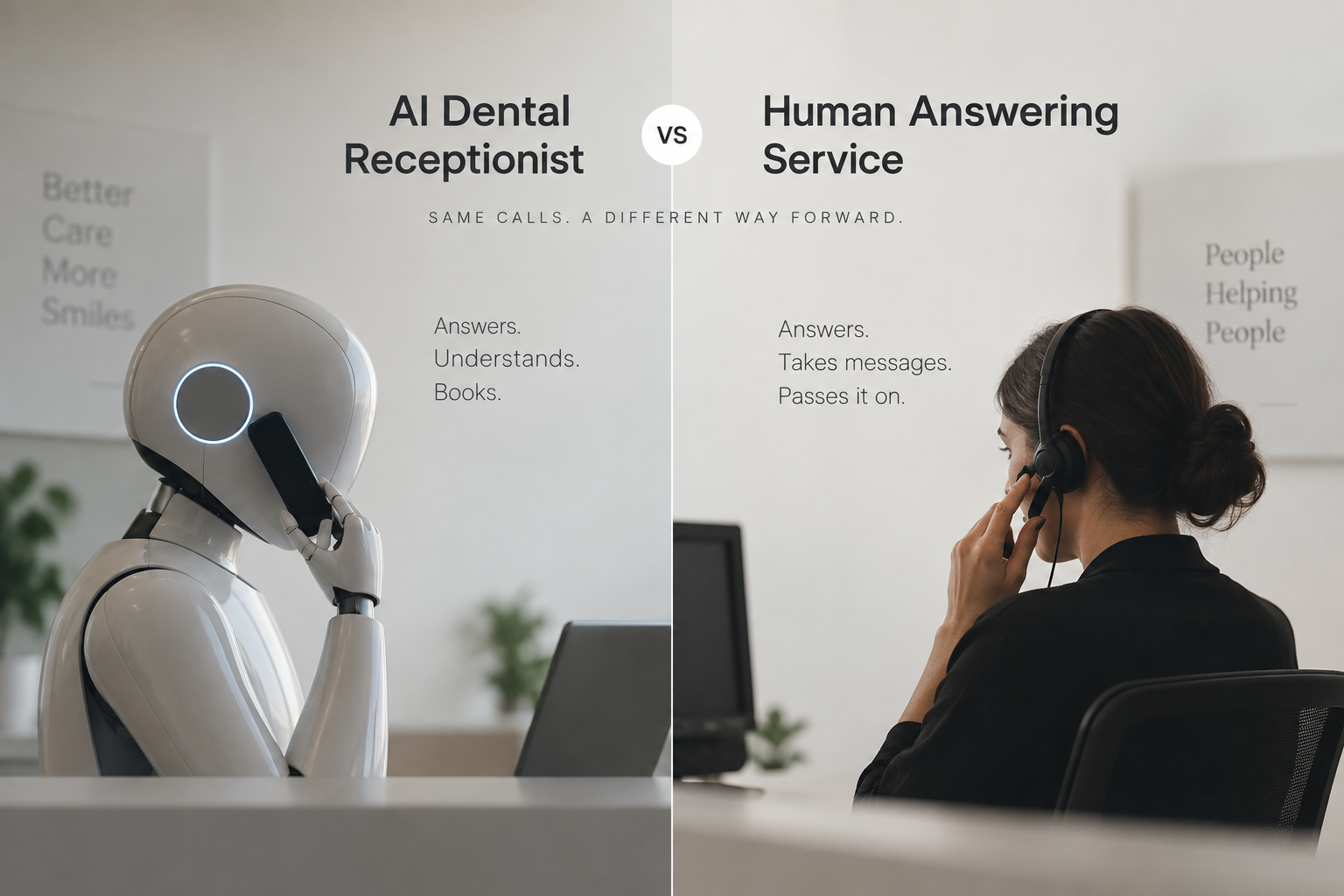
An AI dental receptionist and a human answering service both pick up calls your front desk cannot get to, but they solve different parts of the problem. A human answering service adds more people to cover the phone. An AI receptionist adds coverage that never runs out of hours, connects directly to your scheduling system, and hands a call to your team the moment it needs a person. Which one actually fits your practice depends on your call volume pattern, what you need connected to your calendar and CRM, and how much you want a person versus a system handling the routine requests.
What's the actual difference between the two?
A human answering service is a team of live operators, usually working for a third-party company, who answer on your practice's behalf when your own staff cannot. They take messages, sometimes book appointments manually, and pass information back to your office. An AI receptionist like MTS's answers the call directly, uses the information your practice has already provided (services, appointment rules, hours, policies, common patient questions) to understand what the caller needs, and can move the request forward itself, such as booking or rescheduling, without a person typing notes into a separate system afterward.
The practical difference shows up in what happens after the call ends. A human answering service typically leaves you with a message to act on later. A system connected to your CRM and calendar can complete the request during the call itself.

How does coverage actually compare?
Both models can offer 24/7 coverage; that part is not the differentiator it used to be. The difference is in consistency and cost of that coverage. A live-operator service scales its price with call volume and hours covered since it is paying real people to staff those hours. An AI receptionist's coverage does not vary by time of day. A call at 11 p.m. gets the same handling as a call at 11 a.m., which matters most for practices whose call volume spikes outside business hours (new-patient inquiries after work, urgent questions on weekends).
What does each actually cost, structurally?
Neither category publishes one standard number, so treat any quote you get as a starting point to verify, not a fixed rule. Live-answering-service vendors price themselves publicly: Specialty Answering Service lists plans "starting at just $44 per month," and Abby lists plans "from $165/mo," both scaling up with call volume and features. That per-minute or per-call cost structure means your bill moves with how busy your phones are.
MTS does not publish pricing here, in keeping with the site's standing no-pricing-without-context rule; the honest way to compare is to ask any vendor, AI or human, exactly what drives their price up: is it call volume, minutes, seats, or a flat platform fee, and does that number change if your practice has an unusually busy month.
What about compliance and patient information?
Both models can be built to handle patient information responsibly, but the mechanism differs. A live-operator service depends on that specific operator following your privacy procedures on every call. A system-based AI receptionist can be structured so a human can review and correct what it does on every call, not just occasionally audit a transcript after the fact. As one recent piece from MTS's founder put it, a technically compliant system is not automatically a trustworthy one; the thing that actually earns a practice's trust is a human able to see and correct what the AI does, not just a certification that says the data was handled correctly. Ask any AI receptionist vendor, including MTS, exactly what human oversight looks like on their system before assuming "compliant" means "hands-off."
How does scheduling and PMS integration actually differ?
This is where the two categories diverge the most. A human answering service typically takes a message or, at best, checks availability manually and calls or messages your office to confirm. An AI receptionist connected to your CRM and calendar can check real availability and book or reschedule directly during the call, using the same booking workflow your own front desk would use. If your practice already runs on a specific PMS or CRM, ask any AI receptionist vendor exactly what "integration" means for that system: does it read live calendar data, or does it just generate a message for a person to act on later? The two answers are not the same thing, even if both get marketed as "integration."
See How It Works walks through that exact flow, from a missed call to a booked appointment on your calendar, if you want to see the mechanics before comparing vendors.
How consistent is call quality between the two?
A live-operator service's quality depends on that specific person's training, familiarity with your practice, and how busy their call queue is that day. An AI receptionist's answers come from the information your practice configured it with (services, appointment rules, practice information, clinic hours, policies, common patient questions, escalation rules), so the same question gets handled the same way regardless of time of day or how many other calls are happening at once. That consistency is real, but it comes with an honest tradeoff: if your practice information changes and nobody updates what the AI knows, it will confidently give an outdated answer. A human operator can sometimes catch and question something that does not match what they remember hearing before; an AI receptionist follows what it was configured with until someone corrects it.
Does a human still matter with either option?
Yes, with both. A live-operator answering service is people the whole way through, so "does a human matter" is not really the question there. For an AI receptionist, the honest answer is that some calls should not stay with automation at all: a distressed patient, an unusual request, anything outside what the system was configured to handle. A system worth using can hand the conversation to your team immediately when that happens, rather than trapping the caller in a loop. Ask specifically how a handoff works, not just whether one exists.
So which one should you actually choose?
If your call volume is low and mostly predictable, a live-operator answering service can be the simpler starting point; you are paying for people, and the pricing scales with how much you use it. If your calls spike unpredictably, if you want requests resolved during the call instead of message-and-callback, or if you already run a CRM or PMS you want the phone connected to, an AI receptionist is built for exactly that gap. The decision comes down to whether you are trying to add more people to your phone coverage, or trying to remove the phone from being a bottleneck in the first place. Those are different problems, and it is worth being honest with yourself about which one your practice actually has before picking either option.
Related reading: if missed calls specifically, not just general coverage, are the problem you are trying to solve, the Missed-Call Text-Back piece walks through what that specific fix looks like for a dental practice.
Related articles

Dental AI Software Comes in 2 Kinds. Only One of Them Answers Your Phone.
Most "dental AI software" lists mix X-ray tools with receptionists. They solve different problems. Here's the split, and what the front-office kind actually does.

Do Dental Offices Use AI to Answer Calls?
A growing number of dental offices use AI to answer at least some of their calls. Here's what that actually looks like on a call, and where a person still steps in.

7 Dental KPIs That Show Where Revenue Leaks Before It Hits Production
Production and collections tell you a month went badly. These 7 front-office numbers tell you why, early enough to do something about it.